






Odor Index & Odor Concentration Testing
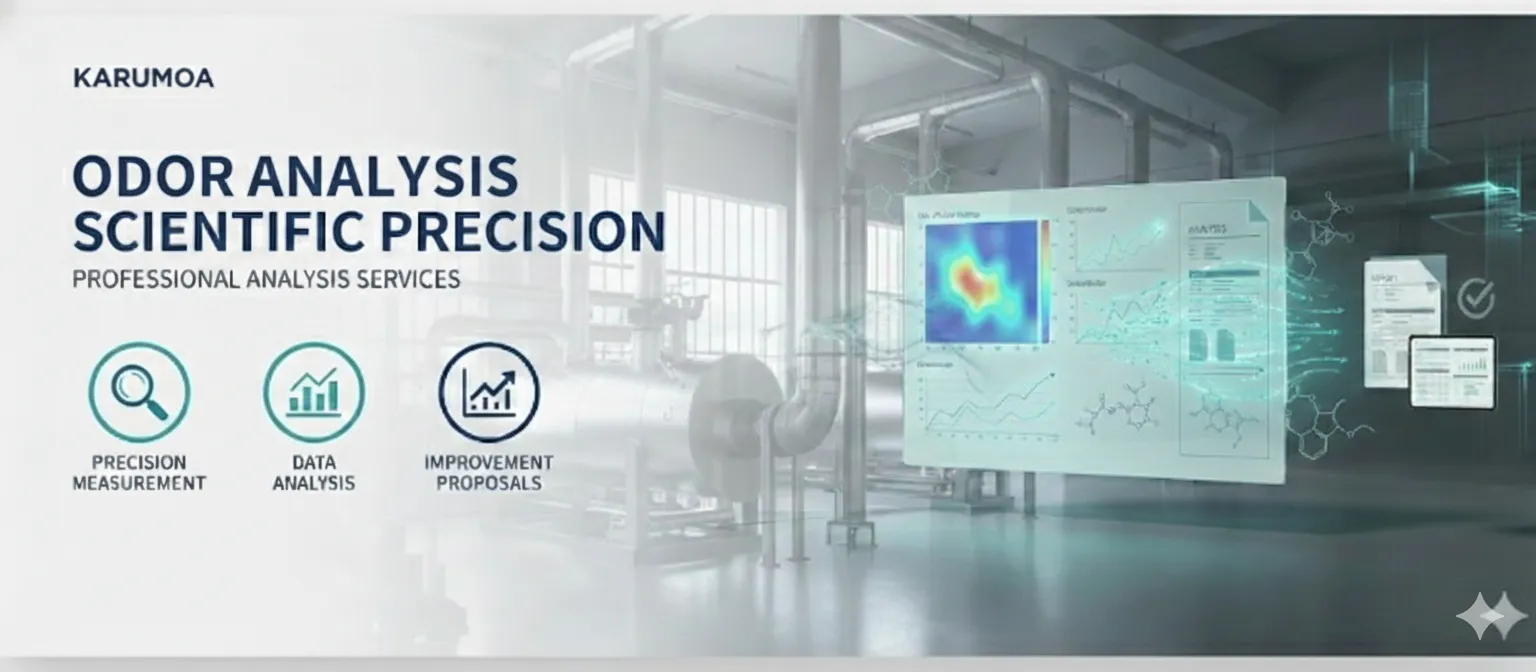
Official Odor Measurement
Odor Index & Odor Concentration Testing — Certified odor assessors
measure your facility’s odor levels using the official olfactometry method, providing
legally compliant data for regulatory response and complaint resolution.
Regulatory Compliant
Triangle Bag Method
Full Report Provided
Why Choose Kalmor for Odor Measurement
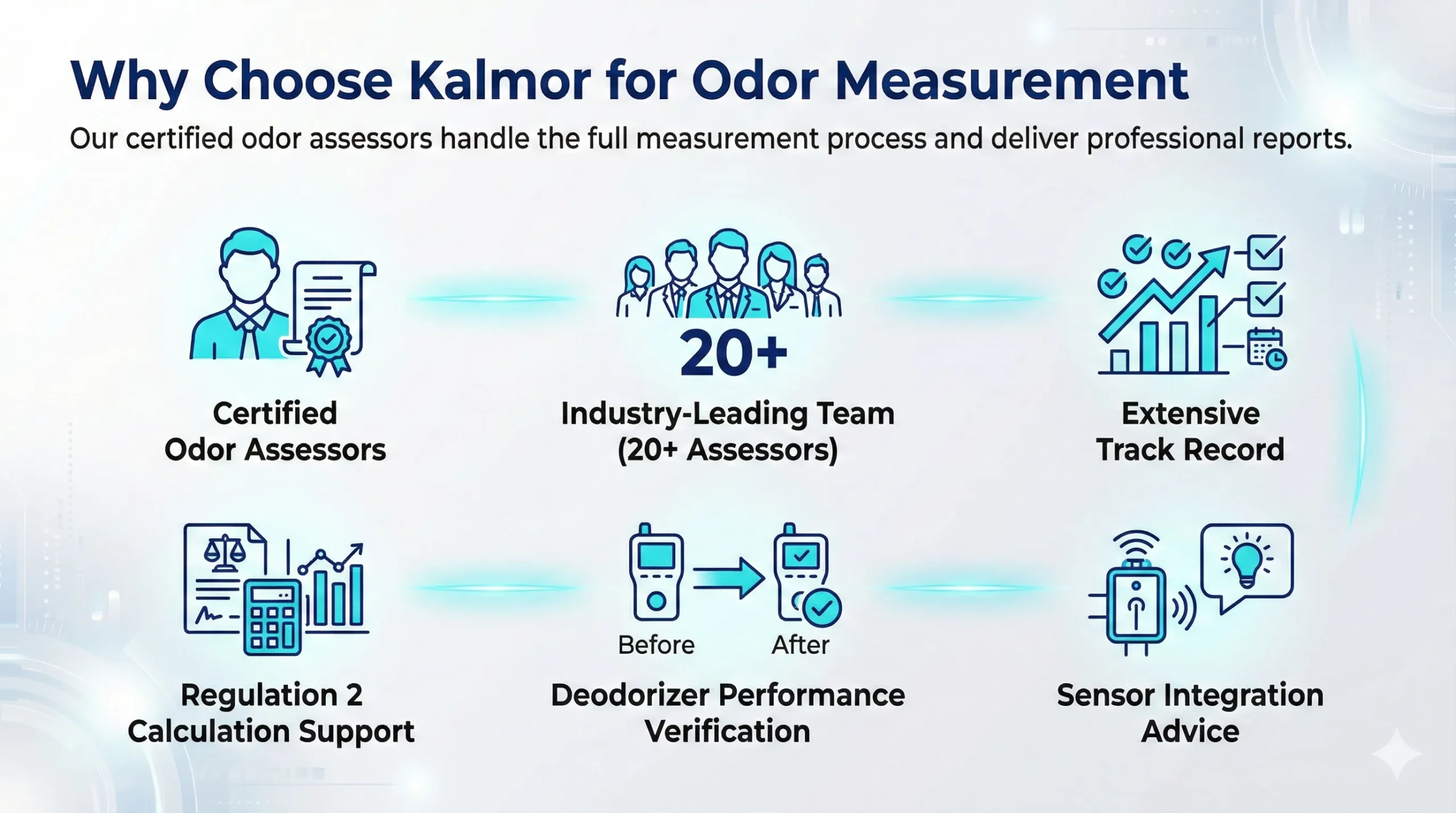
Our certified odor assessors handle the full measurement process and deliver professional reports.
Certified Odor Assessors
All measurements performed by nationally certified “Odor Judges” (臭気判定士) —
the legally designated professionals for odor index measurement under Japan’s
Offensive Odor Control Law.
Industry-Leading Team
With 20+ certified assessors on staff, Kalmor has one of the largest
teams of odor measurement specialists in the industry, ensuring rapid
response and consistent quality.
Extensive Track Record
Proven experience in odor index/concentration measurement across
hundreds of projects — factory exhaust, boundary surveys, complaint
investigations, and routine environmental monitoring.
Regulation 2 Calculation
Beyond measurement, we support Regulation 2 (emission rate-based)
calculations, regulatory compliance strategy, and complaint resolution planning.
Deodorizer Performance Verification
Measure before and after deodorizer installation to verify
effectiveness with official odor index values — not just sensor readings.
Sensor Integration Advice
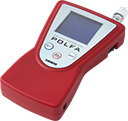
We also advise on combining olfactometry with odor sensors (POLFA, LIMOS)
for cost-effective ongoing monitoring between official measurements.
What is Odor Index & Odor Concentration?
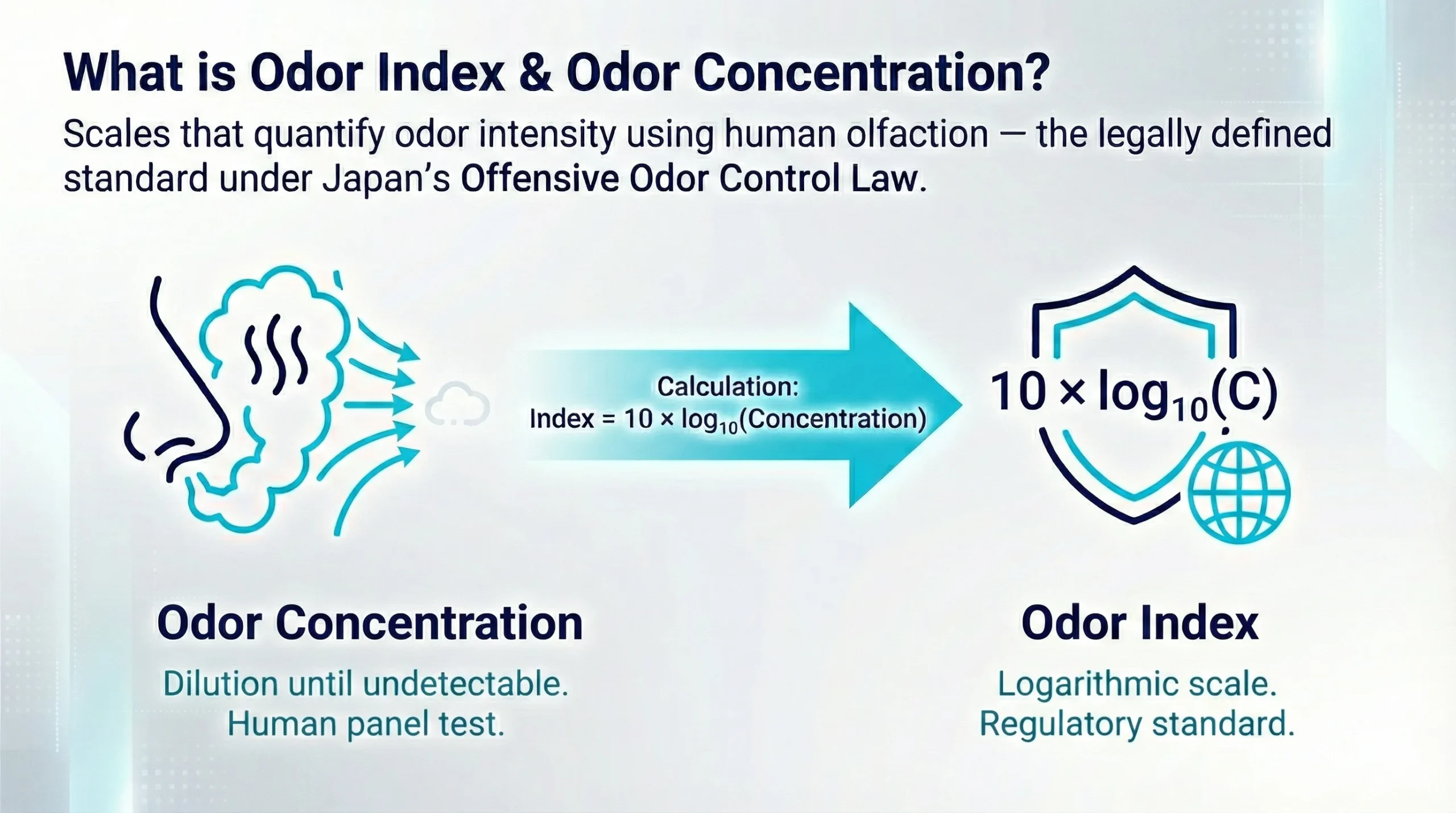
Scales that quantify odor intensity using human olfaction — the legally defined
standard under Japan’s Offensive Odor Control Law.
Odor Concentration
The number of times a sampled odor must be diluted with odorless clean air
until it becomes undetectable. A higher value = stronger odor. This is
determined through human panel testing, not instruments.
Odor Index
Calculated as: Odor Index = 10 × log₁₀(Odor Concentration).
This logarithmic scale is used as the regulatory standard for odor regulation
in Japan and is equivalent to methods used internationally.
5 Advantages of Olfactometry
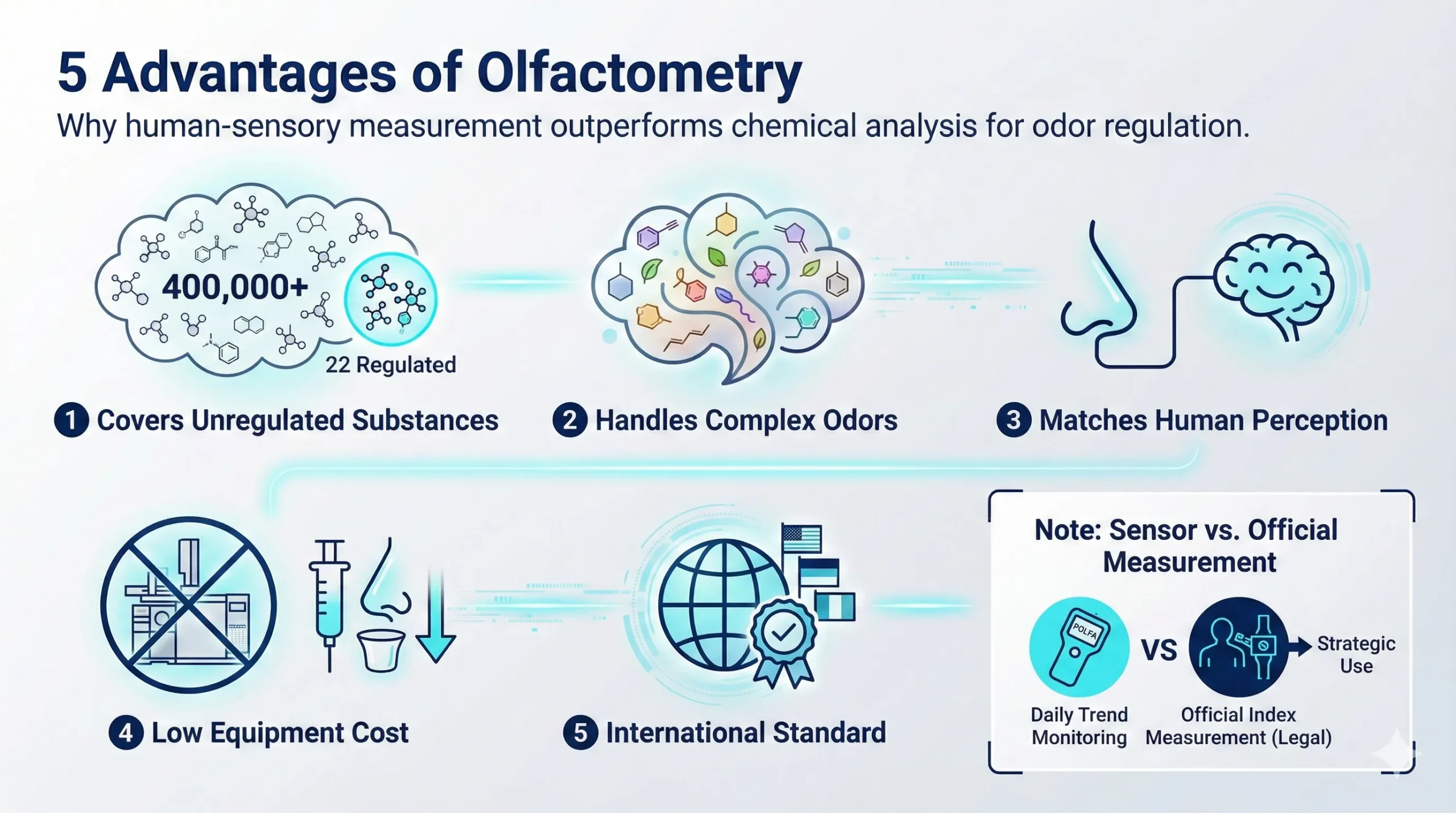
Why human-sensory measurement outperforms chemical analysis for odor regulation.
Covers Unregulated Substances
Over 400,000 odorous compounds exist, but only 22 are designated as regulated
substances. Olfactometry captures the total odor impact regardless of composition.
Handles Complex Odors
Most real-world odors are mixtures (complex odors). Olfactometry naturally
accounts for additive and synergistic effects between compounds.
Matches Human Perception
Since the method uses human noses, results align directly with
how residents experience odors — critical for complaint resolution.
Low Equipment Cost
No expensive analytical instruments (GC/MS etc.) are needed for the
measurement itself, making it cost-effective for routine compliance.
International Standard
Olfactometry (syringe method, scentometer, olfactometer, etc.) is the mainstream
approach globally. Only a few countries rely solely on specific substance regulation.
Sensor vs. Official Measurement
Odor sensors (like POLFA) are useful for daily trend monitoring, but cannot
substitute for official odor index measurements required by law. Use both
strategically for the most cost-effective odor management.
How Odor Index Is Measured
The Triangle Odor Bag Method — Japan’s designated olfactometry procedure.
On-site Sampling
A certified assessor visits your facility and collects odor samples
at exhaust points, site boundaries, or complaint-relevant locations
using standardized sampling bags.
Sample Preparation
Back in the measurement lab, the operator (certified assessor) prepares
diluted samples by injecting collected odor into odorless-air bags
at progressively higher dilution ratios.
Panel Testing
A panel of testers is presented with 3 bags — 1 containing diluted odor,
2 containing clean air. They identify which bag has the odor. This is
repeated at increasing dilutions until detection fails.
Calculation
The dilution ratio at which the panel can no longer detect the odor
becomes the Odor Concentration. The Odor Index is then calculated as
10 × log₁₀(Odor Concentration).
Official Report
A detailed measurement report is provided, documenting all sampling
locations, conditions, panel results, calculated odor index values,
and regulatory compliance assessment.
Comparison of Odor Measurement Approaches
Different methods serve different purposes. Choose based on your needs.
| Method | What it measures | Best for | Limitation |
|---|---|---|---|
| Olfactometry (Odor Index) | Overall odor intensity perceived by human nose | Regulatory compliance, complaint resolution, official documentation | Requires certified assessor; not instant |
| Chemical Analysis (GC/MS) | Concentration of specific chemical compounds | Identifying specific substances, source analysis | Cannot capture total “smell” of mixtures |
| Odor Sensor (POLFA, LIMOS) | Relative odor intensity (sensor value) | Daily trend monitoring, before/after checks | Not legally recognized for regulatory compliance |
Not sure which measurement approach you need? Describe your situation and
we’ll recommend the most practical combination.
FAQ
What is a “Certified Odor Assessor” (臭気判定士)?
A nationally certified professional designated by Japan’s Offensive Odor Control
Law as the qualified person for measuring odor index and odor concentration.
Kalmor has 20+ certified assessors — one of the largest teams in the industry.
Can a sensor replace official olfactometry?
No. Sensor readings (POLFA, LIMOS, etc.) are valuable for daily trend monitoring
but are not legally recognized as odor index values. For regulatory compliance,
administrative response, or official documentation, olfactometry by a certified
assessor is required.
Can you also help with odor complaint resolution?
Yes. Most of our clients use measurement as part of a broader odor assessment
(臭気アセスメント) that includes source investigation, priority ranking,
dispersion simulation, and solution planning — not just measurement alone.
Is this service available outside Japan?
Yes. We provide odor measurement consulting internationally. While Japan’s
specific regulatory framework applies domestically, our olfactometry method and
expertise can be applied to facilities worldwide. Contact us for details.
How long does measurement take?
On-site sampling typically takes 1 day. Lab analysis and report preparation
take approximately 1–2 weeks depending on the number of samples and scope.
Need official odor measurement data?
Contact us for regulatory-compliant odor index testing by certified assessors.

Kalmor Technical Services(Foreign Language) 製品一覧
- Factory Exhaust Ceramic Filter Deodorization System “Zeogaia”
- Portable Odor Sensor POLFA
- Ceramic filter deodorizer for kitchen exhaust ZEOGAIA
- Fixed-point odor observation system LIMOS
- Injectable Low-Temperature Plasma Deodorizer NeoPlas
- Industrial Deodorizing Systems
- carbon Deodorization System
- Odor measuring device
- Odor Assessment Service
- Microgel deodorizer
- Powerful Ozonizer
- Odor Index & Odor Concentration Testing